
Understanding the Core Limitations of 2WD Tractors Before You Invest
When expanding or upgrading farm machinery, tractors are almost always the first major investment farmers consider. When browsing the market, buyers inevitably face a key decision: selecting between a 2-Wheel Drive (2WD) and a 4-Wheel Drive (4WD) model. For many small-scale operators or farms with strict budget constraints, an affordable 2WD tractor appears to be the most cost-effective solution initially.
However, operating a 2WD tractor under real-world agricultural conditions reveals clear performance boundaries. Before making a final purchasing decision, gaining a complete understanding of these functional limits ensures a wiser, long-term machinery investment. Below is a detailed breakdown of the main limitations associated with 2WD tractors and how they compare to 4WD alternatives.
Table of Contents
- 1. Limited Traction and Power Loss
- 2. Increased Risk of Wheel Slip and Getting Stuck
- 3. Reduced Capability for Heavy-Duty Implements
- 4. Compromised Stability and Safety on Rough Ground
- Final Thoughts: Making the Right Choice for Your Farm
1. Limited Traction and Power Loss
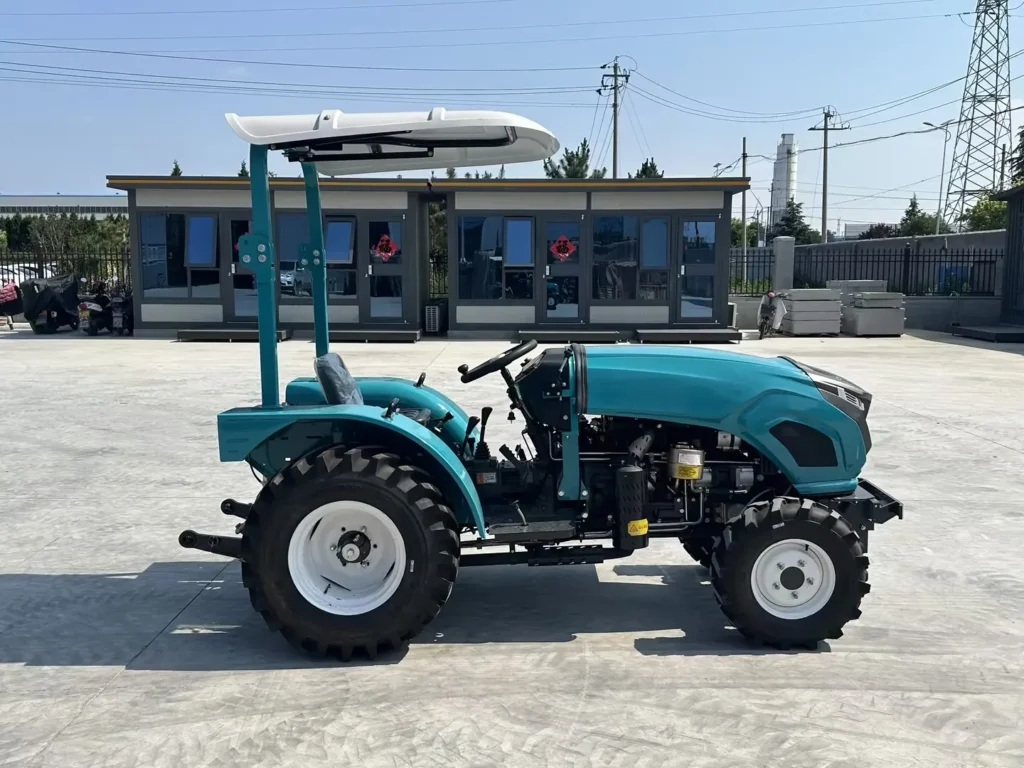
Limited traction represents the primary structural weakness of a 2WD tractor. In a 2WD system, the front wheels serve strictly a steering function, meaning the rear wheels must generate 100% of the pulling force required to move the machine and its trailing equipment.
+-----------------------------------------------------------------------+
|                        2WD DRIVE TRAIN SYSTEM                         |
|                                                                       |
|      [ Front Wheels ]                  [ Rear Wheels ]                |
|      Steering Only  <---------------->  100% Pulling Force            |
|      (No Engine Power)                 (High Risk of Power Loss)      |
+-----------------------------------------------------------------------+
Because drive force is concentrated solely on the rear axle, field performance depends heavily on surface conditions. On soft soils, wet fields, or fields covered with heavy crop residue, rear tires frequently struggle to maintain adequate grip. As a result, valuable engine horsepower is lost to wheelspin rather than being converted into forward momentum.
Field testing demonstrates a significant performance gap between 2WD and 4WD units operating at identical horsepower ratings. During heavy tillage or towing operations, a 2WD model typically delivers only 60% to 70% of the usable traction achieved by a comparable 4WD model.
2. Increased Risk of Wheel Slip and Getting Stuck
Insufficient traction routinely leads to excessive wheel slip, which significantly increases the likelihood of the machine getting stuck in the field.
When rear tires lose their grip, they spin in place instead of driving the machine forward. This process wastes fuel, causes unnecessary tire wear, and leads to severe soil compaction and structure damage. As the spinning rear tires dig deeper into soft ground, the tractor sinks deeper into the mud. Because the front wheels offer no powered traction, a stuck 2WD tractor cannot pull itself out independently.
[Wheel Slip Occurs] ──► [Tire Digs into Mud] ──► [Tractor Sinks] ──► [Towing/Manual Recovery Required]Recovering a stuck machine usually requires towing assistance or manually jamming planks or stones under the tires—process delays that halt field operations and increase labor costs.
- Real-World Scenario: On hilly pastures, early morning dew can turn seemingly firm grass into a slick surface. A 2WD tractor hauling heavy hay bales uphill can easily lose traction midway. Applying additional throttle under these conditions only causes the rear tires to spin and dig further into the turf. The operator is often forced to reverse down the slope and seek a longer, flatter alternative route.
3. Reduced Capability for Heavy-Duty Implements
Primary agricultural tasks—such as deep plowing, subsoiling, heavy disc harrowing, and towing fully loaded trailers—demand strong, sustained draft force. In these heavy-duty scenarios, a 2WD tractor operates at a distinct physical disadvantage.
Increasing engine power alone does not solve the fundamental traction barrier. If the rear tires lack sufficient mechanical grip against the ground, higher engine output simply translates into faster wheelspin and higher fuel consumption rather than increased pulling capacity.
| Field Task | 2WD Performance Challenge | 4WD Advantage |
|---|---|---|
| Deep Plowing & Subsoiling | High tire slip; inability to convert engine power into draft force. | Dual-axle power distribution maintains consistent ground contact and depth control. |
| Grain Transport (Harvest) | Rear-wheel slippage under load; struggles to pull heavy trailers on slopes. | Superior torque distribution allows smooth starts and steady hill climbing. |
| Field Transport on Wet Soil | Loss of momentum, risk of sinking, increased strain on engine. | Front-axle pull assists rear-axle push to prevent momentum loss. |
By contrast, a 4WD tractor distributes engine torque across both axles. This multi-axle drive system allows a much higher percentage of engine power to be converted into effective traction, enabling the tractor to pull heavy implements or fully loaded trailers with greater stability and speed.
4. Compromised Stability and Safety on Rough Ground
A 2WD tractor performs most reliably on dry, flat, and firm terrain. However, when operating on uneven pasture tracks, unpaved farm roads, or post-rain dirt roads, its structural limits become apparent.
The combination of rear-wheel drive and uneven front-to-rear weight distribution creates operational risks on challenging ground. On farms and ranches where livestock feed or supplies must be moved across slopes or uneven fields, a 2WD machine reaching a patch of wet grass or loose gravel can experience a sudden loss of rear grip. This sudden loss of traction deprives the operator of directional control and forward pulling power.
                ▲ 4WD: Front & Rear Traction (Higher Stability)
               /
[Rough Terrain]
               \
                ▼ 2WD: Rear-Only Traction (Higher Risk of Slippage)
Conversely, a 4WD tractor leverages active traction on both front and rear axles, making it significantly safer and more effective when negotiating slopes, crossing field ditches, or traversing rutted roads. For agricultural properties with complex or hilly topography, 4WD capability is essential for both operational efficiency and operator safety.
Final Thoughts: Making the Right Choice for Your Farm
Ultimately, the inherent limitations of a 2WD tractor stem from a single mechanical reality: power is delivered exclusively to the rear axle. Consequently, engine output cannot always be efficiently or consistently transferred to the ground.
While a 2WD tractor remains a practical, cost-effective option for light-duty chores on dry, level land, operating on wet, loose, or sloped surfaces introduces clear risks:
- Increased fuel consumption due to wheelspin
- Frequent operational delays from getting stuck
- Higher maintenance costs and slower completion of heavy-duty field work
Need Guidance Selecting Your Next Tractor?
If you are evaluating equipment options for your farm, the OXPLO team is ready to help. Our extensive 4WD tractor lineup spans multiple horsepower classes, offers customizable configurations, and supports a wide selection of specialized implements tailored to your specific agricultural needs.
Contact OXPLO today to consult with our machinery experts and find the ideal tractor configuration for your farm.